
What if the Bible itself gives us clues to finding Jesus in Obadiah? As it happens, the Bible does give us some clues.
For example, the Bible book of Acts states that Jesus can be found in the words of all the prophets of the Bible. In this post then we will follow the clues in Acts and show that indeed Jesus is to be found in the book of Obadiah. Get ready for a Bible study adventure and let’s go!
Who is Jesus?
Well, before we can understand who Jesus is, we first need an understanding of who God is.
Here is a brief introduction to God. God is a divine Family known as “the Godhead” (Acts 17:29) in the Bible. This Family consists of three divine Persons, namely, the Father, the Son called Christ, and the Holy Spirit.
For those who are new to Bible notation, “Acts 17:29,” for example, is a reference to the Bible, which is a collection of books. In the Bible, each book consists of one or more chapters, and each chapter has numbered sections called verses. The quotation referred to as “Acts 17:29” is taken from the book of Acts in the Bible, the 17th chapter, and the 29th verse.
Jesus then is the name that was given to Christ when He was born in human flesh as a baby boy over 2,000 years ago.
Why did Christ come to the earth? He came because it was God’s will that even though “the wages of sin [which is evil and wrongdoing] is [eternal] death [annihilation]…[yet] the gift of God is eternal life through Jesus Christ our Lord.” Romans 6:23.
Now you may be asking, What is God like? “God is love” (1 John 4:8) meaning that the identical love exists in the heart of each member of the Godhead and this love defines what is true love. The members of the Godhead never contradict each other at any time and, so, we can truly say, “There is one God.” Mark 12:32.
Our Bible Verses of Focus
The following Bible verses will be our focus in this post. “For Moses [a leader of ancient Israel] truly said unto the fathers, A prophet [Jesus Christ] shall the Lord your God raise up unto you of your brethren, like unto me; him shall ye hear in all things whatsoever he shall say unto you…Yea, and all the prophets from Samuel and those that follow after, as many as have spoken, have likewise foretold of these days.” Acts 3:22, 24.
These verses in Acts tell us that Jesus Christ is to be found in the sayings of all the prophets in the Bible. So, clearly then Jesus is to be found in the sayings of the prophet, Obadiah, which are contained in the book called by his name, that is, the book of Obadiah.
Our Mission in This Post
The book of Obadiah is the shortest book in the Bible. It consists of one chapter which has 21 verses. Our mission in this post is to follow the clues given in the following verses from the book of Acts to find Jesus in Obadiah.
“But those things, which God before had shewed by the mouth of all his prophets, that Christ should suffer, he hath so fulfilled.” Acts 3:18. So, according to Acts 3:18, we should be able to find a reference to Christ’s sufferings and death in Obadiah.
Christ “whom the heaven must receive until the times of restitution of all things, which God hath spoken by the mouth of all his holy prophets since the world began.” Acts 3:21.
According to Acts 3:21, we should find in Obadiah a reference to the time to come. The time when sin has been eliminated from the universe, and the earth has been restored to its original beauty and the perfection as was found in the garden of Eden, which God had created.
“For Moses [a leader of ancient Israel] truly said unto the fathers, A prophet [Jesus Christ] shall the Lord your God raise up unto you of your brethren, like unto me; him shall ye hear in all things whatsoever he shall say unto you…Yea, and all the prophets from Samuel and those that follow after, as many as have spoken, have likewise foretold of these days.” Acts 3:22, 24.
According to Acts 3:22-24, we should find in Obadiah a reference to the birth (incarnation) of Christ and Christ’s work for humanity.
“To him give all the prophets witness, that through his name whosoever believeth in him shall receive remission of sins.” Acts 10:43. So, according to Acts 10:43, we should find in Obadiah a reference to the forgiveness of sins by God because of Christ’s work for humanity.
Our mission then is to search in Obadiah for these four things mentioned in the book of Acts about Jesus.
The Book of Obadiah
Here are all the 21 verses of the book of Obadiah. As you can see it is a short book.
Read through it from the beginning to the end, but don’t worry if you don’t understand all of it. The overview is that the book of Obadiah is a prophecy from God against the nation of Edom.
Edom Will Be Humbled
Obadiah 1:1 The vision of Obadiah. Thus saith the Lord GOD concerning Edom; We have heard a rumour from the LORD, and an ambassador is sent among the heathen [non-Jews], Arise ye, and let us rise up against her [against Edom] in battle.
Obadiah 1:2 Behold, I have made thee [Edom] small among the heathen [non-Jews]: thou art greatly despised.
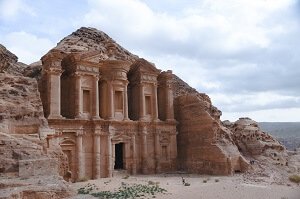
Obadiah 1:3 The pride of thine heart hath deceived thee, thou that dwellest in the clefts of the rock, whose habitation is high; that saith in his heart, Who shall bring me down to the ground?
Obadiah 1:4 Though thou exalt thyself as the eagle, and though thou set thy nest among the stars, thence [from there] will I bring thee down, saith the LORD.
Obadiah 1:5 If thieves came to thee, if robbers by night, (how art thou cut off!) would they not have stolen till they had enough? if the grapegatherers came to thee, would they not leave some grapes?
Obadiah 1:6 How are the things of Esau searched out! how are his hidden things sought up!
Obadiah 1:7 All the men of thy confederacy have brought thee even to the border: the men that were at peace with thee have deceived thee, and prevailed against thee; they that eat thy bread have laid a wound under thee: there is none understanding in him.
Obadiah 1:8 Shall I not in that day, saith the LORD, even destroy the wise men out of Edom, and understanding out of the mount of Esau?
Obadiah 1:9 And thy mighty men, O Teman, shall be dismayed, to the end that every one of the mount of Esau may be cut off by slaughter.
Edom’s Violence Against Jacob (Israel)
Obadiah 1:10 For thy violence against thy brother Jacob [Israel] shame shall cover thee, and thou shalt be cut off for ever.
Obadiah 1:11 In the day that thou stoodest on the other side, in the day that the strangers carried away captive his forces, and foreigners entered into his gates, and cast lots upon Jerusalem, even thou wast as one of them.
Obadiah 1:12 But thou shouldest not have looked on the day of thy brother in the day that he became a stranger; neither shouldest thou have rejoiced over the children of Judah in the day of their destruction; neither shouldest thou have spoken proudly in the day of distress.
Obadiah 1:13 Thou shouldest not have entered into the gate of my people in the day of their calamity; yea, thou shouldest not have looked on their affliction in the day of their calamity, nor have laid hands on their substance [goods] in the day of their calamity;
Obadiah 1:14 Neither shouldest thou have stood in the crossway, to cut off those of his that did escape; neither shouldest thou have delivered up those of his that did remain in the day of distress.
The Day of the Lord Is Near
Obadiah 1:15 For the day of the LORD is near upon all the heathen [non-Jews]: as thou hast done, it shall be done unto thee: thy reward shall return upon thine own head.
Obadiah 1:16 For as ye have drunk upon my holy mountain, so shall all the heathen [non-Jews] drink continually, yea, they shall drink, and they shall swallow down, and they shall be as though they had not been.
Obadiah 1:17 But upon mount Zion [ancient Jerusalem] shall be deliverance, and there shall be holiness; and the house of Jacob [house of Israel] shall possess their possessions.
Obadiah 1:18 And the house of Jacob [house of Israel] shall be a fire, and the house of Joseph [a son of Jacob] a flame, and the house of Esau for stubble, and they shall kindle in them, and devour them; and there shall not be any remaining of the house of Esau; for the LORD hath spoken it.
The Kingdom of the Lord
Obadiah 1:19 And they of the south shall possess the mount of Esau; and they of the plain the Philistines: and they shall possess the fields of Ephraim, and the fields of Samaria: and Benjamin shall possess Gilead.
Obadiah 1:20 And the captivity of this host of the children of Israel shall possess that of the Canaanites, even unto Zarephath; and the captivity of Jerusalem, which is in Sepharad, shall possess the cities of the south.
Obadiah 1:21 And saviours shall come up on mount Zion [ancient Jerusalem] to judge the mount of Esau; and the kingdom shall be the LORD’S.
Obadiah and Acts 3:18—Christ’s Sufferings and Death
Now Acts 3:18 speaks of Christ’s sufferings and death, and the question we are faced with is, Where in Obadiah does it speak of these things about Christ?
On reading through, Obadiah, the answer seems to be that Christ is not spoken of anywhere in the book. But this cannot be the correct answer given what Acts 3:18 states: “But those things, which God before had shewed by the mouth of all his prophets, that Christ should suffer, he hath so fulfilled.” Acts 3:18.
What should we do then? The answer is to look at the meaning of the words in the language in which it was originally written, that is, the Hebrew language. Don’t worry you do not need to know Hebrew to accomplish this task.
The only thing you need to grasp now is that the Strong’s Concordance assigns a Strong’s Number to every Hebrew and Greek word in the original Bible. So, a Strong’s Number starting with H is a Hebrew word and a Strong’s Number starting with G is a Greek word. Many other resources that give the meaning of the Hebrew and Greek words of the Bible use the Strong’s Number.
Now, from a careful reading through of Obadiah, the verse Obadiah 1:7 stands out as a possible answer to our question because it mentions a wound and Christ was wounded.
Just a note here. Jesus Christ died “for the sins of the whole world” (1 John 2:2), rose from the dead to life again, and ascended to heaven from where He had come to the earth. Christ will return to a second time on God’s Judgment Day.
The Word “Wound” in Obadiah 1:7
Here is Obadiah 1:7—“All the men of thy confederacy have brought thee even to the border: the men that were at peace with thee have deceived thee, and prevailed against thee; they that eat thy bread have laid a wound under thee: there is none understanding in him.” Obadiah 1:7.
We will now consider the meaning of the Hebrew word in Obadiah 1:7 which was translated into English as the word “wound.” To do so we will use Strong’s Concordance and the Brown-Driver-Briggs Hebrew Definitions.
Both of these references are available in the free E-Sword Bible software for the PC, Apple Mac, iPad, and iPhone. However, E-Sword is not available for Android smartphones. (Update: E-Sword is now available for Android at the Google Play Store. Cost is US$2.99 as at April 30, 2022.) Instead, use the Blue Letter Bible App for Android smartphones which is available for free at the Google Play store.
Analysis of Obadiah 1:7
The Strong’s Number for the word “wound” in Obadiah 1:7 is H4204 which in Hebrew means “in the sense of turning aside from truth; treachery, that is, a plot.”
Ah! Here we have found what we are looking for, because certainly there was treachery and plots against Jesus Christ. This ultimately led to Christ being murdered by His hands and feet being nailed to a t-shaped wooden structure called a “cross” where He hung until He died. This was the result of one of His disciples and some of the Jewish leaders and people turning aside from the truth about Christ.
Let us also consult the reference Brown-Driver-Briggs Hebrew Definitions (BDB). According to the BDB, the Hebrew word with Strong’s Number H4204 means a “net, [or a] trap” and “in the sense of turning aside from truth.” So, the BDB confirms what Strong’s Concordance says.
Thus, when Obadiah says —“they that eat thy bread have laid a wound under thee” (Obadiah 1:7), we see that it is a reference to Judas, one of Christ’s disciples, who ate at the table with Christ and who betrayed Christ into the hands of Christ’s enemies.
But what about the phrase “there is none understanding in him” (Obadiah 1:7)? Well, according to Job 28:28, “to depart from evil is understanding” and we can readily see that Judas knew not how to depart from evil because He betrayed Christ.
So, we can conclude that the phrase —“they that eat thy bread have laid a wound under thee: there is none understanding in him” (Obadiah 1:7) does refer to Christ’s sufferings and death.
Obadiah and Acts 3:21—The Restoration of All Things
Acts 3:21 speaks of Christ “whom the heaven must receive until the times of restitution of all things, which God hath spoken by the mouth of all his holy prophets since the world began.” Acts 3:21.
So, we expect to find in Obadiah a reference to the restoration of all things, that is, “the times of restitution of all things.” Acts 3:21. What does this “restitution” (Acts 3:21) mean in the Bible?
The Word “Restitution” in Acts 3:21
The Strong’s Number for “restitution” in Acts 3:21 is G605 which in the Greek language means “reconstitution.”
“Reconstitution” according to TheFreeDictionary.com means “To put or change (something) back to its original form.”
Now we know that everything on earth changed when the first human pair, a man named Adam and a woman named Eve, whom God created holy, fell into sin, which is evil and wrongdoing. So, Acts 3:21 points to time when things on earth will go back to their original state.
Let us also consult two more resources to find the meaning of the word “restitution” in Acts 3:21. These resources are Thayer’s Greek Definitions and the Mounce Concise Greek-English Dictionary both of which are available in the free E-Sword Bible software.
According to Thayer’s Greek Definitions for the Strong’s Number G605, the meaning of “restitution” in Acts 3:21 is “Restoration of a true theocracy and restoration of the perfect state before the fall” of Adam and Eve into sin.
So, Acts 3:21 points to a time when God will be the Supreme Ruler on earth such that God’s law of love reigns on earth. That is, Acts 3:21 points to the time when the current rule on earth by Satan, the angel who tempted Adam and Eve to sin and succeeded, will be done away with, in that, his law of wickedness will be replaced by God’s law of love.
Further, the Mounce Concise Greek-English Dictionary’s entry for the Strong’s Number G605 states that the meaning of “restitution” in Acts 3:21 is “A restitution or restoration of a thing to its former state; hence, the renovation of a new and better era.” This essentially agrees with both the Strong’s Concordance and Thayer’s Greek Definitions.
So, now we know what we are looking for in Obadiah, the only question is, Where in Obadiah can this be found? By searching the book of Obadiah, the answer seems to lie in Obadiah 1:21.
Analysis of Obadiah 1:21
Here is Obadiah 1:21—“And saviours shall come up on mount Zion [ancient Jerusalem] to judge the mount of Esau; and the kingdom shall be the LORD’S.” Obadiah 1:21.
The answer to our question is the phrase “the kingdom shall be the LORD’S.” Obadiah 3:21.
So then the kingship, the realm, the kingdom, that is, the earth, shall be fully and completely under the reign of the self-existent One, the one true God, Jehovah at “the times of restitution of all things.” Acts 3:21.
Obadiah and Acts 3:22, 24—The Birth of Christ and His Work for Humanity
Acts 3:22, 24 states “For Moses [a leader of ancient Israel] truly said unto the fathers, A prophet [Jesus Christ] shall the Lord your God raise up unto you of your brethren, like unto me; him shall ye hear in all things whatsoever he shall say unto you…Yea, and all the prophets from Samuel and those that follow after, as many as have spoken, have likewise foretold of these days.” Acts 3:22, 24.
As was said before, this is a reference to the birth (incarnation) of Christ and Christ’s work for humanity.
The question now is, Where in Obadiah do we find such a reference to Christ? Once again, the answer seems to lie in the verse, Obadiah 1:21.
Another Analysis of Obadiah 1:21
Here is Obadiah 1:21 again—“And saviours shall come up on mount Zion [ancient Jerusalem] to judge the mount of Esau; and the kingdom shall be the LORD’S.” Obadiah 1:21.
This time around in looking at Obadiah 1:21, we are looking at the phrase —“And saviours shall come up on mount Zion [ancient Jerusalem] to judge the mount of Esau.” Obadiah 1:21.
We will now investigate the meaning in the Hebrew language of two words in Obadiah 1:21—“saviours” and “judge.”
The Word “Saviours” in Obadiah 1:21
The Strong’s Number H3467 for “saviours” in Obadiah 1:21 means “Causatively to free or succor.” This Hebrew word has been variously translated into English as “deliverer, help, rescue, bring salvation, save, saviour.” Here then is a clear reference to Christ’s birth (incarnation) and His work for humanity, for Christ was all these things to humanity.
The Brown-Driver-Briggs Hebrew Definitions entry for the Strong’s Number H3467 states the meaning of “saviours” as “To save, deliver, to save from moral troubles, to give victory to.” Here again is confirmation that Obadiah 1:21 refers to Christ’s birth (incarnation) and His work for humanity, for Christ was all these things to humanity.
The Word “Judge” in Obadiah 1:21
The Strong’s Number H8199 for “judge” in Obadiah 1:21 according to Strong’s Concordance means “By implication to vindicate.” It has also been translated into English as the word “defend.”
Now TheFreeDictionary.com gives the meaning of “vindicate” as “To clear of accusation, blame, suspicion, or doubt with supporting arguments or proof.”
This is exactly what Christ did for humanity. For to those people who keep God’s law of love, God promises “Every tongue that shall rise against thee in judgment thou shalt condemn. This is the heritage of the servants of the LORD [God], and their righteousness is of me, saith the LORD [God].” Isaiah 54:17. They shall be cleared of all blame and accusations.
Also, Brown-Driver-Briggs Hebrew Definitions (BDB) entry for the Strong’s Number H8199 states the meaning of “judge” as “vindicate.” So, the BDB agrees with Strong’s Concordance.
Summary of the Analysis of Obadiah 1:21
According to Obadiah 1:21 then a Saviour, a Deliverer from sin (Jesus Christ), shall be born in ancient Israel to vindicate (justify) the mount of Esau, that is, the people of Edom.
Here then is a reference to the incarnation of Christ and His work for the saving of humanity from eternal death (annihilation).
Obadiah and Acts 10:43—The Forgiveness of Sins by God Through Christ
Acts 10:43 states “To him give all the prophets witness, that through his name whosoever believeth in him shall receive remission of sins.” Acts 10:43.
As was said before then, according to Acts 10:43, we should find in Obadiah a reference to the remission (forgiveness) of sins by God because of Christ’s work for humanity.
Let us now consult our three previous resources for the meaning of the word “remission” in the Greek language.
The Word “Remission” in Acts 10:43
The Strong’s Number for “remission” in Acts 10:43 is G859 which in the Greek language means “(figuratively) pardon.” It has been variously translated into English as “deliverance, forgiveness, remission.”
This confirms that what we are looking for in Obadiah is a reference to the forgiveness of sins.
The entry in Thayer’s Greek Definitions for Strong’s Number G859 states that the meaning of “remission” is “release from bondage or imprisonment, forgiveness or pardon, of sins (letting them go as if they had never been committed), remission of the penalty.” This agrees with Strong’s Concordance.
The entry in Mounce Concise Greek-English Dictionary for Strong’s Number G859 states that the meaning of “remission” is “remission, forgiveness, pardon.” This agrees with both Strong’s Concordance and Thayer’s Greek Definitions.
So, what we are looking for in Obadiah is a reference to the forgiveness of sins. On searching through the book of Obadiah, the reference seems to lie in the verses, Obadiah 1:19, 20.
Analysis of Obadiah 1:19, 20
Here is Obadiah 1:19, 20—“And they of the south [the region of southern Judah, where Judah was the southern kingdom of ancient Israel] shall possess the mount of Esau; and they of the plain the Philistines: and they shall possess the fields of Ephraim, and the fields of Samaria: and Benjamin shall possess Gilead. And the captivity of this host of the children of Israel shall possess that of the Canaanites, even unto Zarephath; and the captivity of Jerusalem, which is in Sepharad, shall possess the cities of the south.” Obadiah 1:19, 20.
Here we want to understand the meaning of the word “possess” in Obadiah 1:19, 20 as this might hold the evidence that these verses in Obadiah refer to the forgiveness of sins.
The Word “Possess” in Obadiah 1:19, 20
Strong’s Concordance gives the Strong’s Number H3423 for “possess” in Obadiah 1:19, 20 as meaning “by implication to seize, to rob, to inherit.” The corresponding Hebrew word has been translated variously into English as “get (have) in (take) possession, seize upon.”
Brown-Driver-Briggs Hebrew Definitions gives the Strong’s Number H3423 for “possess” in Obadiah 1:19, 20 as meaning “to seize, dispossess, take possession off, inherit, disinherit, be an heir.”
Now none of these meanings seem to be a reference to the forgiveness of sins. However, let us consider the following Bible verses.
Summary of Analysis of Obadiah 1:19, 20
Here are the verses that we will consider now: “How can one [Christ] enter into a strong man’s [Satan’s] house, and spoil [plunder] his goods, except he [Christ] first bind the strong man [Satan]? and then [Christ] he will spoil [plunder] his [Satan’s] house.” Matthew 12:29.
“No man can enter into a strong man’s [Satan’s] house, and spoil [plunder] his goods, except he [Christ] will first bind the strong man [Satan]; and then he [Christ] will spoil [plunder] his [Satan’s] house.” Mark :27.
“When a strong man [Satan] armed keepeth his palace, his goods are in peace: But when [Christ] a stronger than he shall come upon him [Satan], and overcome him, [Christ] he taketh from him [Satan] all his armour wherein he trusted, and divideth [deliver over to God] his [Satan’s] spoils.” Luke 11:21, 22.
Here the goods and the spoils are the human race which Satan “the devil…[has] taken captive…at his will.” 2 Timothy 2:26. All humanity then are initially in bondage to sin and Satan for they “cannot cease from sin.” 2 Peter 2:14.
But there is good news! Christ rescues human beings, who so desire to be rescued, from the hands of Satan and forgives them of their sins. We see than that the word “possess” in Obadiah 1:19, 20 refers to the rescue of humanity from Satan and, by implication, refers to the forgiveness of sins.
So, according to Obadiah, Edom shall be rescued from the hands of Satan, forgiven their sins by God through Christ and, hence, become a part of spiritual Israel, who are the saved of all the earth, that is, those who will receive eternal life from God. Likewise, so shall the Philistines, Ephraim, Samaria, Gilead, the Canaanites even unto Zarephath, and the cities of the south become part of spiritual Israel and themselves receive eternal life from God.
God’s Law of Love in Action
So, we have found in Obadiah the four things that the book of Acts says should be found in it about Jesus.
Specifically, we have found in Obadiah, Christ’s birth (incarnation) and work for humanity, His sufferings and death, His forgiveness of sins, and the restitution of all things.
All of this demonstrates that in Christ we see God’s law of love in action. For Christ in His perfection “condemned sin in the [human] flesh” (Romans 8:3) and Christ has made it possible for humanity to have eternal life in an earth restored to its original state of Edenic beauty.
You may be asking, How is this so? Well, Christ, the Innocent One, took upon Himself the sins of guilty humanity and died the death that humanity deserved. More than this there is the wonderful news of imputed righteousness.
That is, there is a marvellous substitution. For when any human being has “repentance toward God, and faith toward our Lord Jesus Christ” (Acts 20:21), God accepts Christ’s death in place of the person’s death for their own sins, and imputes (credits, ascribes) Christ’s righteousness to the repentant sinner’s account. As a result of this substitution, known as the atonement, God forgives their sins and now treats the sinner as if they had never sinned. In addition, God by His grace, which is His unmerited favour to humanity, gifts (imparts) to the person Christ’s righteousness so that they can cease from sinning.
All of this means that the person has been “justified by faith” (Romans 5:1), that is, God now declares the person to be righteous. So, the person is no longer under the condemnation of God’s law of love because of their sins, but instead are at peace with God.
Isn’t God wonderful! Here is a revelation of the gospel of Christ, which is God’s plan for saving humanity from eternal death (annihilation). It is a glorious plan in which justice and mercy are combined. Justice in that Christ died for all sins, and mercy in that a way is opened for guilty humanity to be saved. Christ is indeed a Treasure to humanity. Praise God!
Conclusion
In this post, we have looked closely at the book of Obadiah according to what our Bible verses of focus says: “For Moses [a leader of ancient Israel] truly said unto the fathers, A prophet [Jesus Christ] shall the Lord your God raise up unto you of your brethren, like unto me; him shall ye hear in all things whatsoever he shall say unto you…Yea, and all the prophets from Samuel and those that follow after, as many as have spoken, have likewise foretold of these days.” Acts 3:22, 24.
Thus, we have found, as the book of Acts says, four things relating to Christ in the book of Obadiah.
In fact, Acts says that these four things are to be found in the sayings of all the prophets. So, here is a Bible study of all the other prophets that you should now have some knowledge of how to undertake it.
Christ is revealed all throughout the Bible as humanity’s Saviour from their sins. Now, after all that God has done to save you, make sure that you are among the saved of humanity to live happily forever with God.
Note that through my daily Bible reading, I was led to things the book of Acts says about Christ and all the prophets, including the prophet, Obadiah. In addition, an English Dictionary was utilised in looking up the meaning of some English words found in Obadiah. Lastly, a Bible Concordance was used to find the meanings of Hebrew and Greek words, as necessary, to unpack the book of Obadiah as it relates to Christ.
The Bible Teaches Us How to Obtain Eternal Life from God
“In the beginning was the Word [Christ], and the Word [Christ] was with God, and the Word [Christ] was God.” John 1:1. “And the Word [Christ] was made flesh [was born as a baby boy named Jesus], and dwelt among us [human beings], (and we beheld his glory, the glory as of the only begotten of the Father).” John 1:14. Thus, Christ, whose “name is called The Word of God” (Revelation 19:13) is the One who gave the whole Bible to humanity, from the Bible’s beginning to its end. Further, “God is love.” (1 John 4:8), which is to say, Christ is love.
And every one of you as a human being are to “lay apart [put away] all filthiness and superfluity [abundance] of naughtiness [of wickedness], and receive with meekness the engrafted [the implanted] word [from God, which is the Bible and], which is able to save your souls [from annihilation by God as the penalty for sin].” James 1:21. For the word of God, the Bible, being implanted in us means that “the love of God is shed abroad [is poured] in our hearts by the Holy Ghost [the Holy Spirit] which is given unto us.” Romans 5:5. So then, “love is of God; and every one [every human being] that loveth is born of God, and knoweth God.” 1 John 4:7. This is known as “justification” (Romans 4:25) which is accomplished by our repentance, that is, our deep sorrow for our sins and the gift of faith from God, which when exercised to believe God’s promise of forgiveness of sins and cleansing from sin brings us the gift of love from God. Note that everyone receives the gift of faith from God but without repentance people have a superficial faith and not saving (correct) faith that takes proper hold of God’s truth by the working of the Holy Spirit.
Immediately upon our justification, God tests our character to see if we will successfully resist all temptation to sin. Our success depends on our exercising faith in Christ’s keeping power through the Holy Spirit and, hence, we become sanctified (made holy) and thus receive eternal life from God.
And this is life eternal [everlasting life], that they [as human beings] might know thee the only true God, and Jesus Christ, whom thou hast sent [to the earth as a Deliverer from sin].” John 17:3. Thus, when the whole Bible makes our character a character of perfect love, it means that we know God and, hence, we will receive eternal life from God.
How This Blog Teaches Bible Study
My blog posts take one or more Bible verses and unpack what is often the hidden meaning in them, to help you to gain in your understanding of the Bible, and to receive insights into how to study it. For God says, “Study [the Bible] to shew [show] thyself approved unto God, a workman that needeth not to be ashamed, rightly dividing [interpreting] the word of truth [the Bible].” 2 Timothy 2:15. There are new blog posts every two weeks on a Monday at 12:01 a.m. in timezone UTC-5 (GMT-5).
Further Reading
Do read online or download my free Ebook “Victory in Christian Warfare.” This book teaches you how to have a close, intimate relationship with God who rewards those who know Him in this way with eternal life with Him. See my other free Ebook and links to purchase books at Amazon here.
Image: Emile Guillemot at unsplash.com.
Leave a Reply