
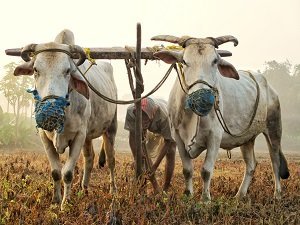
“Where no oxen are, the crib [feeding trough] is clean [empty]: but much increase is by the strength of the ox.” Proverbs 14:4.
(Note that “Proverbs 14:4” is a reference to the Bible, which is a collection of books. In the Bible, each book consists of one or more chapters, and each chapter has numbered sections called verses. The quotation above referred to as “Proverbs 14:4” is taken from the book of Proverbs in the Bible, the 14th chapter, and the 4th verse.)
Our Bible verse of focus in this post, Proverbs 14:4, has literal and symbolic meanings which we will explore. The context of Proverbs 14:4 is agriculture in ancient Israel and the Bible has much to say about Israel. Therefore, an overview of the history of the earth and of Israel will help to anchor our study in place and time.
Creation to the Flood
God is the “Creator”’ (Ecclesiastes 12:1) of all there is in the universe. Sin, which is evil and wrongdoing, began on earth with the first human pair, Adam and Eve. Wickedness became widespread so God brought a flood upon the earth. All humanity died in the flood except for eight persons preserved in the ark, which was a covered boat. From these eight persons, Noah and his wife, his three sons and their wives, was the earth repopulated.
The History of Israel: Abraham to the Promised Land
The people of the repopulated earth were no different from the wicked people who lived before the flood. Therefore, God chose a godly man named Abram, whose name God later changed to Abraham, and made promises to him.
The promises God made to Abraham He passed on to godly descendants of Abraham, namely, Isaac his son, and Jacob, his grandson. Jacob’s name God changed to “Israel” (Genesis 32:28) and so “the children of Israel” (Genesis 32:32) became the nation of Israel in 1445 B.C.
The abbreviation “B.C.” means “before Christ” and refers to the time before Christ was born on earth as a baby boy named “Jesus.” Matthew 1:21.
The History of Israel: 1445 B.C.-586 B.C.
The nation of Israel consisted of twelve tribes with each tribe made up of the descendants of one of the twelve sons of Jacob. In 931 B.C., the nation of Israel was split into two kingdoms, namely, Israel to the north and Judah to the south.
As a result of their wickedness and idolatry, God caused the kingdom of Israel consisting of the ten northern tribes to be taken by Assyria into captivity in 722 B.C. Likewise, in 586 B.C. God caused the kingdom of Judah consisting of two tribes to be taken into captivity by the Babylonians.
The History of Israel: 586 B.C.-395 A.D.
The region of the land of Israel was ruled by consecutive world powers from 605 B.C. to 395 A.D. These powers were “Babylon” (2 Kings 17:24), “Persia” (2 Chronicles 36:20) (also known as Media-Persia), “Greece” (Zechariah 9:13), and “Rome.” Acts 2:10. The only exceptions were short periods of Jewish independence, namely, the Maccabean Revolt (167 B.C.-161 B.C.) and the Hasmonean Dynasty (157 B.C.-129 B.C.)
It was during the period of Roman rule that Christ was born in in human flesh in approximately 5 B.C. On earth, Christ was known as “Jesus of Nazareth.” John 1:45. Jesus Christ was put to death by crucifixion in 31 A.D.
The abbreviation “A.D.” means “Anno Domini ” and refers to the year when Christ was born in human flesh. However, due to an error it was discovered that Christ was not born in 1 A.D., but in 5 B.C. Nevertheless, 31 A.D. means 31 years after Christ was born on earth.
The History of Israel: 395 A.D.-2020 A.D.
In 395 A.D., the final partition of the Roman Empire occurred when it was split into the eastern and western kingdoms. The region of the land of Israel, known as Palestine, was then a part of the Eastern Roman Empire which became known as the Byzantine Empire, and which was Christian. In about 635 A.D., Palestine was conquered by an Arab army and became a part of the Arab Empire.
From 1099 A.D.-1291 A.D., the Roman Catholic Church waged wars, known as the Crusades, in the region and took control of what was considered holy sites. Subsequently, the Mamluks of Egypt ruled Palestine from 1291 A.D.-1517 A.D. The Ottoman Empire (1516 A.D.-1917 A.D.) next ruled over Palestine.
Next, 1918 A.D.-1920 A.D., Palestine was ruled by the Occupied Enemy Territory Administration (OETA) by a joint British, French, and Arab military administration. Between 1920-1948, Palestine was under British rule. As of 1948, the region of Palestine became the independent, modern state of Israel which still exists today in the year 2020.
Agriculture in Ancient Israel: The Seasons
The region of ancient Israel had only two seasons each year. These were the rainy season, which ran from autumn to spring, with its “early and latter rain” (James 5:7) and a dry season in summer.
The early rain came in late October or in November and softened the soil sufficiently for the farmer to plow and sow seeds in his fields. These rains were comparatively light, but toward the end of December came the heavier rains with the greatest rainfall coming usually in January. This water deeply penetrated the soil and caused the crop to grow.
However, a good harvest depended upon the right amount and timing of the latter rain which were the last showers of the season and which came in March and early April.
The latter rain promoted the ripening of the grain. If the last rainy months yielded only meager precipitation, a poor harvest might be the result even if the earlier rainfall was good. From May through October there was practically no rain.
Agriculture in Ancient Israel: Sowing and Reaping
“Wheat” (Genesis 30:14) was a common crop in ancient Israel. Plowing was done in the autumn and the plow was drawn by a pair of oxen yoked together. The plow made shallow furrows in the soil, about 3 to 4 inches deep, into which the seed was sown.
When the grain was ripe it was harvested using a sickle, which was an agricultural tool with a wooden handle and a curved blade.
Agriculture in Ancient Israel: Threshing
The wheat was then threshed thus separating the husks, the “chaff” (Job 21:18), and the straw from the kernel of wheat.
Threshing was done on a threshing floor which belonged either to one owner or, more commonly, to a whole community. The threshing floor was usually situated outside the village on a flat piece of ground about 50 feet in diameter. If the terrain was uneven, the threshing floor was artificially built up. It was usually placed where the west wind had easy access, for a wind was needed for the winnowing which always followed the threshing.
Threshing was done in two ways. One way was to drive animals (mainly oxen) round and round on the grain to tread it. The other way was to have the animals pull threshing sledges or carts over the grain.
The Bible mentions two kinds of threshing sledges. One kind was probably an instrument made of heavy planks of wood curved upward at the front, with sharp pieces of stone or metal attached to the bottom. The other kind was associated with cart wheels and it is therefore assumed that it described the threshing cart, such as was used in Egypt. This cart consisted of a wooden frame with two or three axles to which toothed wheels were attached.
The sharp stones/metal of the threshing sledge or the wheels of the threshing cart cut into the grain as they were pulled over it separating the kernels from the husk and straw.
Agriculture in Ancient Israel: Winnowing
After the husk was loosened by the preliminary process of threshing, winnowing took place. Winnowing was the process of separating the chaff from the grain by means of the wind.
Most ancient threshing floors were situated on elevated places, so that as the threshed-out grain is thrown high into the air by means of a shovel or a fork, the wind blows the chaff away. As a result, the purified grain falls to the ground in a heap.
Winnowing was usually done in the evening when the wind had the most favourable velocity. In a long windless spell, large fans plied by helpers might have supplied an artificial wind for winnowing.
Agriculture in Ancient Israel: Milling Grain
After winnowing, the grain was ground into flour using a mill and the flour used to make bread. Mills in ancient times were either rubbing hand mills, rotating hand mills, or commercial mills turned by slaves or by animals. In each case, the grain was crushed and ground into flour between two stones rotated or rubbed against each other.
The Literal Meaning of Proverbs 14:4
Literally then Proverbs 14:4 means that if one has no oxen to plow one’s field, to thresh, winnow, or mill grain, there will be no food for the animals or for human beings. On the other hand, if one puts oxen to work in plowing, threshing, winnowing, and milling, there will be much food, both for the animals and for human beings.
The Labour of Christ
“God anointed Jesus of Nazareth [Christ] with the Holy Ghost and with power: who went about doing good, and healing all that were oppressed of the devil; for God was with him.” Acts 10:38.
Also, there was a day “when [Jesus Christ] he called unto him his disciples: and of them he chose twelve, whom also he named apostles.” Luke 6:13. Just before His death, Jesus Christ prayed to His Father in heaven. Christ prayed, “I have manifested thy name unto the men which thou gavest me out of the world: thine they were, and thou gavest them me; and they have kept thy word.” John 17:6. “I have glorified thee” (John 17:4), I have manifested your character of love, “on the earth: I have finished the work which thou gavest me to do.” John 17:4.
So then, Jesus Christ was an effective labourer on earth in the cause of God, which is the saving of humanity from eternal death. Symbolically then He was as an ox labouring to bring forth a harvest, not a harvest of food but a harvest of souls won to God. Such converted persons will receive eternal life from God.
The Labour of the Christian
Christ gives a gospel commission to all Christians, who are His followers. His commission is, “As my Father hath sent me, even so send I you.” John 20:21 “Go ye into all the world, and preach the gospel to every creature [person].” Mark 16:15. You “are labourers together with God.” 1 Corinthians 3:9.
“Remember the word that I said unto you, The servant is not greater than his lord. If they have persecuted me, they will also persecute you; if they have kept my saying, they will keep yours also.” John 15:20.
Thus, symbolically, the Christian just like Jesus Christ is to be as an ox labouring to produce a harvest. As a labourer in the cause of God, their commission is to win souls to Christ.
To the Christian then God says, “Therefore, my beloved…be ye stedfast, unmoveable, always abounding in the work of the Lord, forasmuch as ye know that your labour is not in vain in the Lord.” 1 Corinthians 15:58. That is, to the labouring Christian God promises that they will surely reap a harvest of souls won to Christ.
This then is the literal and symbolic meanings of Proverbs 14:4.
How This Blog Teaches Bible Study
My blog posts take one or more Bible verses and unpack what is often the hidden meaning in them, to help you to gain in your understanding of the Bible, and to receive insights into how to study it. For God says, “Study [the Bible] to shew [show] thyself approved unto God, a workman that needeth not to be ashamed, rightly dividing [interpreting] the word of truth [the Bible].” 2 Timothy 2:15. There are new blog posts every two weeks on a Monday at 12:01 a.m. in timezone UTC-5 (GMT-5).
Further Reading
Do read online or download my free Ebook “Victory in Christian Warfare.” This book teaches you how to have a close, intimate relationship with God who rewards those who know Him in this way with eternal life with Him. See my other free Ebook and links to purchase books at Amazon here.
Image: Gunjan Bhattacharjee at unsplash.com.
Leave a Reply